Pages

Showing posts with label SAP Profiles. Show all posts

Tuesday, July 23, 2013

Mel Knourek - how SAP's flex time solution helps her to reach her goals

by Angela Schuller, SAP

If you work at SAP, you’re dedicated, meticulous and focused on the helping the company achieve its business objectives. At home, you’re committed to your family, your friends and ultimately, your life goals. All of us demonstrate the passion that makes us successful and hopefully brings us the happiness and sense of accomplishment we all deserve. The North America News team recently spent some time with one SAP employee whose journey brings her that sense of personal gratification and requires her to find the inner strength to accomplish her goal…quite literally. Mel Knourek, Executive Assistant to Jeff Harvey and John Tully, is just weeks away from competing in the 2013 World Masters Games (WMG) in Turin, Italy, hoping to break the world record for Olympic weightlifting for women.

“I’ve been a fighter since the day I was born,” said Mel. “I was born at 27 weeks and weighed less than 3 pounds.” Battling an eating disorder through adolescence and adulthood, Mel’s life has been a series of ups (graduating from the U.S. Marine Corps with a firefighting certificate) and downs (a bad marriage exasperating three auto-immune diseases). One of the ups, Mel remembers, was finding ice hockey. A natural skater, Mel found friends and a new confidence to live a happier life.

“I discovered a passion for being fit and healthy when I started playing ice hockey,” said Mel. Working with a friend to strengthen her tiny 88-lb frame, she soon joined CrossFit, a principal strength and conditioning program used at police academies and with tactical operations teams, military special operations units, and hundreds of other elite and professional athletes worldwide, and channeled her passion for fitness into an Olympic weightlifting program 2.5 years ago to simply improve her strength and technique. Four months into the program, Mel showed so much promise, she was informed she could compete in the 2013 World Masters Games [NA News Note: The World Masters Games promotes and encourages mature athletes from all over the world to compete at the Olympic level. Mel jokingly refers to the WMG as the “Old People Olympics.”]

Mel credits SAP's Flex Appeal Program in giving her the flexibility in her schedule to work and train for this event. “If I need to work in the evening, I simply bring my laptop to work while I train,” she says. Her managers have supported this arrangement so Mel can excel both in the workplace and in her personal life, as well.

When not working or training for the upcoming competition, Mel still finds time to coach CrossFit classes and mentor other women. Her eating disorder? The auto-immune diseases? They’re in remission. Now weighing 125 pounds, Mel credits the 180 degree turn in her life to finding her passion. “It’s not about a medal…it’s about proving I am a somebody,” she explained.

Tuesday, June 18, 2013

Moving Into the Arena: A Lesson in Inspirational Leadership

by Carol Mackenzie, SAP

Carol Mackenzie, Industry Advisor Senior Manager, SAP
AtelierSAP is a unique community of senior ex-SAP executives, largely engaged in current entrepreneurial pursuits. As part of my participation in the Leadership Excellence Acceleration Program  (LEAP) at SAP, I attended their third annual leadership event.  I was humbled to be in the company of such an accomplished group. I came away from the event with many pages of notes, two partnership possibilities to investigate supporting my current role, and one viable future mentor to connect with.

Primarily, however, I walked away pondering a singular theme that spoke to me personally and surfaced repeatedly throughout the session: inspirational leadership. What does it look like today? Who has it? How do you attain it and model it? In a world where inspiration comes from pop culture (non)superstars and overpaid, over-drugged sports figures, how does a “steady” life in business inspire the Millennials of today?

Several speakers touched on the topic throughout the two days, but two presenters in particular resonated with me. Each integrated their own points of view to reinforce the call to action: more than ever, every organization needs more of it.


Les Hayman (left)  & Tom Pfister
Les Hayman, ex CEO/Chairman SAP and SAP EMEA and Global Head of HR, presented “Ten Rules of Management”, where inspirational aspects were woven throughout. Starting with the premise that management is more about how you manage yourself, rather than how you manage others, he made the case that understanding yourself (your beliefs, ethics, the environment you create) is the key to inspiring others. Without this baseline, there is no foundation on which to build credibility, passion, results. You need to provide people with the “freedom to fly”; to take their strengths and provide the safe climate to permit running with them, always keeping in mind it is “meant to be fun” along the way.

At the event of the event, Luisa Delgado, ex-member of the Executive Board and Global Managing Board of SAP AG and former Chief Human Resources Officer, also spoke to us. Joining the event via Skype from SAP’s headquarters in Walldorf, she commented that discretionary effort of the individual is the true differentiator today – and having leaders that inspire work effort above and beyond being a new standard as operating practice.  Leaders who create an environment where people truly want to do more, where emotional intelligence is more important than intellectual intelligence, where heart is becoming more of a key attribute in business strategy – these are today’s inspired few.

Who has inspired me personally?  It’s a small number…people with vision, steadfast beliefs, people of action. Steve Jobs, Hillary Clinton, Abe Lincoln, Dwight Eisenhower are a few on the list. In my 20+ year career, I can name three individuals that helped shape me into the professional I am today by challenging, guiding, driving my thinking and execution to beyond what I ever thought I could accomplish on my own. 

So this, then, is my own definition of inspirational leadership: Finding the best people, and putting them “ in the arena”.  This statement by Theodore Roosevelt wraps it together nicely:

It is not the critic who counts; nor the man who points out how the strong man stumbles, or where the doer of deeds could have done them better.  The credit belongs to the man who is actually in the arena, whose face is marred by dust and sweat and blood; who strives valiantly; who errs, who comes short again and again …… and at the worst, if he fails, at least fails while daring greatly, so that his place shall never be with those cold and timid souls who neither know victory nor defeat.

Pushing people into the arena involves letting their absolute strongest aptitudes have an opportunity to shine, and setting goals into somewhat uncomfortable zones that leverage those aptitudes. I think about what my team (and myself) could do if we felt the freedom to fail/freedom to thrive. 

Inspirational leaders are the people you want to be around to feel their energy, their passion, their devotion. To see their results and the next area they tackle. More often than not, they make conversations less about themselves and more about others. They live in the arena. 

Do you?


all photos permission and credit: www.conradlouischarles.com

Tuesday, May 14, 2013

FIVE MINUTES WITH DIANE FANELLI - SVP, GLOBAL PRESALES AND SOLUTIONS

by Kate Dieffenbach


When did you start working at SAP and why did you choose to join SAP?

Diane: I was working as an IT Manager in a clothing manufacturing company and was the lead on an ERP package they were installing—it was there I got the bug for what ERP can do. A friend of mine who worked at SAP recommended if I wanted to stay in IT I should check out the company. At that time, no one really knew what SAP was and ERP looked very different from what it does now.
My 1994 interview was at the humble Lester offices; there were three people and it was done so well. The clear message I walked away with was: “This is where we’re going. Get in early and help create our future.” We were—are—a learning company that thinks about tomorrow. Our team is able to explore and learn. That’s what I wanted.  By the end of the interview I had a job offer, I accepted and the rest is a blur!

What projects are you currently working on that you are excited about?

Diane: Increasing the impact Presales colleagues have working with our customers in the sales cycle. This organization [Presales] has been around a long time and we’re working to increase the opportunity to showcase our innovation, leveraging our entire team and sharing practices globally.
It’s about working with our customers in a way we haven’t before and that means helping them recognize what’s possible with our platforms and moving them away from seeing us only as an applications and technology company. Doing that artfully and elegantly—mapping the way for a company to utilize an entire platform—it’s a huge change for our organization to make, a huge shift. And we’re capable of it too.
Another project I’m excited about is the program we are putting the final touches on to help get U.S. Military Veterans to work, which we’ll launch in Q4. During my previous role as COO in April 2012, I realized we have a real issue with the number of people in the marketplace trained on our HANA, D&T, Mobility and BI products. I remember thinking “We have to do something about this,” and saw an opportunity to train our Veterans and work together with our partners to place them in the market. Not only does it solve a business problem but it reinforces SAP’s commitment to social responsibility and improving the lives of people everywhere.

What’s on your bucket list?

Diane: I want to travel to all the continents and I have two left open: Africa and Antarctica. To me…I like new things, I’m adventurous, inquisitive. Seeing new cultures is fascinating and I bring back mores, customs and cultures that help me be a better leader, whether that’s in business or my life in general.
SAP has given me the opportunity to do two international rotations (I call myself a Professional Gypsy) in Germany from ’95 to ’96 and Asia from ’07 to ‘10. I like the quest to check out new places and learn new habits and rituals. Absolutely that has helped me become a better global leader.

As a child, what did you want to be when you grew up?

Diane: A teacher. What I do now outside of work is mentor young professionals who are a few years out of college and help them navigate corporate America. It’s not easy, and it’s something I derive a lot of personal satisfaction from. In fact, when I’m not working any longer, I’ll continue to mentor young people, certainly.

What are some of your passions and hobbies that you enjoy outside of the office?

Diane: Bike riding. My husband Ken and I make it a point on weekends to take long rides through the rolling hills of Pennsylvania, logging 40 to 60-mile days, anywhere from late spring to mid-fall. We’ve been doing that for the past 10 years.

If you could have dinner with anyone (living or not), who would it be and why?

Diane: Hilary Clinton. This woman has had quite a career and now she’s Secretary of State. It’s an enormous job with tremendous responsibility. Even being married to Bill—that’s part of the package! I’d love to know how she does what she does.

Monday, April 29, 2013

EMPLOYEE SPOTLIGHT - Jérôme Monteu Nana

A Born Optimist Who's Dedicated to Africa

by Michael Zipf, SAP Global Communications 

A delegation from Africa is visiting SAP; a Cameroonian or other African university wants its students to learn about SAP software; a diversity event featuring African culture is being planned in Walldorf. In cases like these, SAP employees generally turn to Jérôme Monteu Nana for help and advice.

Jérôme is a “go-getter” in the best possible sense of the word, and he’s an expert on francophone Africa too. And it is not just SAP that benefits from his wide network of contacts and tireless commitment to his home country. He is the founder of Europe’s first ever cooperative of Cameroonian “diaspora” (people who have settled far from their ancestral African homelands) and of the German Association of Cameroonian Engineers and Computer Scientists.

He is also an executive member of the Global Cooperation Council (GCC Forum), which promotes dialogue between the northern nations and Africa, Asia, and Latin America. “I have to invest a great deal of time in these official duties on top of doing my regular job. But I don’t see this extra work as a burden,” says Jérôme, who works as a scrum master in Financial Accounting/New Analytics. “I just want to do what I can to work for progress in my home continent.”

Cameroon-born Jérôme came to Germany in 1991 to study electrical engineering – specializing in process information technology – in Wuppertal. Even then, he was active in the service of others – as manager of a club for African students. Ever since leaving Cameroon for Europe, he has always given a great deal of thought to what he and other “diaspora” like him can do to help promote Africa’s development. “It’s all about sharing the knowledge you acquire abroad with the people back home,” he says.

Networker and fundraiser

After graduating, Jérôme worked at a subsidiary of Deutsche Bank, where he came face to face with SAP solutions for the first time. The two must have “gotten along well together” because he applied to SAP soon after and began working in Walldorf in September 2001. Not surprisingly, he was quick to make contact with his African colleagues and founded the “African Community at SAP” (AC@SAP), which currently has about 20 active members. AC@SAP is part of the Cultures@SAP employee network and is involved in collecting donations and supporting a wide range of CSR initiatives, such as providing aid for schoolchildren in Rwanda. “We also share our experiences and come up with ideas of what we can do for Africa,” says Jérôme.

The fact that this is by no means easy in a continent that is plagued by extreme poverty, conflicts, and corruption does not deter him.  “I’m an optimist and I tend to focus more on the progress that we manage to make,” he says. And progress is visible. For example, with the help of the SAP University Alliances Program, Jérôme has helped ensure that an increasing number of universities now teach information and communications technology (ICT) – so that Africans can share in the opportunities offered by mobile communications and other innovative technologies.

It sometimes takes years to convince African universities of the benefits of this kind of education for both teaching staff and students and of a collaborative partnership with SAP, says Jérôme. But there is a growing realization that IT can lead to greater prosperity and that business software can help fight corruption and create better-run companies.

All-round Commitment

“There’s obviously still a long, long way to go,” says Jérôme, but the growing interest among African universities in cooperating with SAP is encouragement enough for him to continue visiting a university to present SAP and the University Alliances Program every time he travels to Africa. It’s important for him that both sides benefit from his commitment: the people of Africa and SAP, which is expanding its position on the African market and helping combat the shortage of SAP specialists there.

Together with his wife, who works in Germany as a doctor, Jérôme wants to show his three young children (aged one, three, and five) that dedication to a cause is worthwhile. “If we try hard, we really can achieve something,” he says. Even though his children are growing up in Germany, Jérôme wants them to know that Africa is their second home. “It’s important to do what you can for people wherever they live,” he says, “because – in the end – they’re all equal.”

Friday, April 26, 2013

FIVE MINUTES WITH KIRSTEN SUTTON (MANAGING DIRECTOR, SAP LABS CANADA)

An interview by Angela Schuller, SAP North America News


Talk about your left brain/right brain balance: Kirsten Sutton, Managing Director of SAP Labs Canada, graduated from culinary school, holds degrees in Linguistics and Creative Writing/English and leads a national team of 1,600 people who design and build solutions that help businesses run better. In January, she received SAP’s Distinguished Leader Award, which acknowledges Kirsten’s exceptional leadership with her Canada Labs teams and within SAP Canada overall.

Angela: What projects are you currently working on that you are excited about?

Kirsten: It’s the work to bridge the Lab organization and the Field organization that I’m most excited about. By that I mean getting our Developers in touch with our customers and, in turn, having our customers meet the people who have designed and built the solutions they use every day to help their business run better.
As a developer in the Labs, your work is often very specific and project based. Rarely do you get to see beyond the component you’re working on. But give them a chance to speak directly to a customer and listen to how they are using our products…it’s transformative. One developer described it this way:  
“I was blown away by a lot of what I saw that day. It opened my eyes to how impressive and suitable purpose-built industry mobile apps are and how excited SAP customers are about using them.”
For our Field team, understanding that the Labs is another asset they can bring to the table to create a unique customer experience, gives them that edge to make a bigger, faster or more meaningful sale and ultimately a stronger relationship with our customers.
Everything for me always comes back to food. It’s like the dynamics in a restaurant. The Lab is like the kitchen: people don’t often see the team producing the fantastic product they are enjoying. The Field, is like the front of house, filled with servers, bartenders—people you always see. But on that rare and special occasion, there’s that moment when the Chef walks out into the dining area and greets everyone and it all comes together to create a totally unique experience. That experience is what I’m excited about making happen. Everyone benefits – it’s good for our Labs employees, our Field team and for our customers.

Angela: Tell us one thing people generally don’t know about you.

Kirsten: People see me dressed up every year for Halloween but are usually shocked when I tell them I made my costume myself. And I don’t just make them for me, but my whole family. Every Halloween for about the last eight years I’ve made costumes based on a theme of some kind. For instance one year we were dressed up like characters from Alice in Wonderland; another year it was The Incredibles and then The Little Mermaid. This year we’re going to be Merida, Queen Elinor and King Fergus from the movie Brave
I don’t know why I like to do it! <laughs> Maybe it’s the challenge. One year my daughter said ‘I want to be SpongeBob for Halloween’ and right away I started to think ‘Hmmm, how am I going to do that’.

Angela: As a child, what did you want to be when you grew up?

Kirsten:  This is a hard one, because it would change; there are a few moments in time. Let’s start with when I was really little, maybe four-years-old. I wanted to be a gift wrapper like you see at the mall. Then when I was a bit older, I was constantly rearranging the furniture in my bedroom. I was about ten and that was when I wanted to be an Interior Designer. Finally in high school I decided to become a Chef, trained for it and worked in the industry for several years, to help pay for university, actually. I secretly still want to be a novelist, tv sitcom writer and a professional poker player, but those are going to have to wait for retirement…

Angela: What are some of your passions and hobbies that you enjoy outside of the office?

Kirsten: Food for sure and there’s a story I have about combining your passion and your work. Our office in Vancouver was the only SAP Lab office without a food program (cafeteria or otherwise). So people either brown bag it or eat at any one of the 75 or so restaurants in our neighbourhood. So when it came time to look at options on implementing a program, I saw a big opportunity.
We worked with the local Business Improvement Association and created Lunch on Us—a reloadable card that only SAP employees can use at 42 restaurants (we started with 12) – so now our neighbourhood restaurants are our cafeteria. Our team took it one step further and created an app for it as well. So, for instance, you can shake your iPhone to choose a place to eat, which I’m always doing; it’s linked into twitter feeds; it can tell you how long the line-ups are and even tell you what your average spend needs to be if you want to stretch your budget to the end of the quarter. [NA News note: With the success of Vancouver’s ‘Lunch on Us’, SAP Labs Toronto recently rolled out a similar program.]

Angela: If you could have dinner with anyone, living or not, who would it be and why?

Kirsten: You know, as a trained chef this question always puts me into a cold sweat! It’s the idea of having to choose one person. How about three? I’d start with King Tut. I’m fascinated with Egyptian history and I’d love to find out the real story about how he died. Next would be one of my all-time favourite writers, Shakespeare. He did some of the best writing—even some of the best insults! I think it’d be a lot of fun to share some wine and listen to him make fun of people he didn’t like. I’d ask all kinds of questions and get to the bottom of the did-he-write-all-that mystery. And third, I’m wavering between Julia Child and Jamie Oliver. But I’d choose Jamie. I’ve been cooking a lot of his meals lately.

Wednesday, April 3, 2013

SAP and NFTE Challenge Young Entrepreneurs

Jacqueline Montesinos Suarez
Head of Corporate Social Responsibility, SAP North America


Dean Sivara, VP of Ideation at SAP, visits high school classrooms throughout the San Francisco Bay Area to promote and recruit students to the SAP Tech Innovation Challenge, developed with the Network for Teaching Entrepreneurship (NFTE).

The SAP Tech Innovation Challenge incentivizes young people from low-income communities to pursue business ideas using technology (such as websites and mobile apps). NFTE Bay Area students who participate in this Challenge are invited to attend workshops with dedicated SAP volunteers in Palo Alto to refine details of their business plans. Later in the spring, Challenge participants and NFTE students across the country present their business plans, with the goal of advancing to the National Youth Entrepreneurship Challenge. Finalists compete to win cash prizes and NFTE recognition. Past winners created innovative businesses such as “New Types,” a service company that provides individualized computer tutoring in the homes of senior citizens and “TattooID,” which sells temporary safety tattoos for children.

Dean has worked with NFTE for several years, and submits they are an ideal partner for SAP. “Their focus on empowering young people to discover their entrepreneurship spirit needed in the business world is invaluable. I am always inspired when I talk to the students. Their ideas are incredible and it’s important that SAP supports great programs like this,” he says. SAP hopes to build on the success of the 2013 Tech Innovation Challenge to take this to the national level by 2014.

The Network for Teaching Entrepreneurship inspires young people from low-income communities to find their paths to success. They work closely with educators in high-need schools to re-engage students in learning, introduce them to business concepts, and open up their possibilities for the future.

Monday, March 25, 2013

EMPLOYEE SPOTLIGHT - SIDDHARTHA RAO

Technologist. Author. Leader
By Aritraa Mitra


It was the summer of 2004 and the beautiful weather beckoned one to be outdoors. However, Siddhartha Rao, now head of SAP Product Security APJ, was confined to his home in Germany, nursing a broken knee.
Missing the intellectual discussions that he regularly enjoyed with his colleagues at SAP AG, he turned to online communities for conversation. Instead of spending his time on just any social networking community, Siddhartha logged on to a vibrant forum of more than 100,000 registered developers: CodeGuru.com.

Troubleshooter par excellence

Browsing through the forums, Siddhartha discovered that his experience in Windows application and driver programming enabled him to answer many of the questions that various perplexed users had asked. Enthused, he got to work, helping developers right away.
Whether the questions related to the CString class – used to manipulate text information — or passing SAFEARRAY within VARIANTs, Siddhartha had a solution. Often he would not only provide code snippets, but also fully functional projects to help members test their solutions.
In addition to helping with problems at a technical level, Siddhartha detected and solved various problems at algorithmic levels that helped the community. His expert contributions were soon noticed. Acknowledged as an expert in all matters technical, he was made a moderator of the development community. Within a couple of years, Siddhartha had voluntarily provided approximately 6,000 solutions.
Siddhartha says that forums like CodeGuru have been a source of invaluable joy to him: “It is not only the intellectual stimulation, but getting to know other technologists at CodeGuru that was the icing on the cake. When I started with CodeGuru, I never ever thought I would get to eventually meet such nice people and interesting personalities.”

Microsoft MVP

Microsoft soon recognized Siddhartha’s efforts to help the development community at CodeGuru. The company named him a Microsoft Most Valuable Professional (MVP) for Visual Studio – Visual C++ for three years in a row (from 2005 to 2007). As an MVP, he was invited by Microsoft to participate in various MVP events, such as the Global Summit at Redmond, Microsoft TechEd at Barcelona, and networking meets at Munich.
“It was an enriching experience to meet software experts from around the world as well as professionals from Microsoft that make the company go round,” Siddhartha says.
During one of these events at Redmond, where Siddhartha was reviewing Microsoft Visual Studio 2008 in development, a fellow Microsoft MVP (and an author) suggested that Siddhartha write a book for Pearson, a large education company and book publisher with brands such as Addison-Wesley, SAMS Publishing, Que, and Penguin Group in its portfolio.

Teach Yourself C++

Once Siddhartha learned that Pearson sought an author with his type of expertise, he “burnt the midnight oil and spent one vacation too many” to write Teach Yourself C++ in One Hour a Day. The 768-page book provides comprehensive insights about the C++ language, and examines frameworks such as the Standard Template Library (STL) that make C++ so powerful and versatile. The book also teaches the language from the basics for beginners, as well as introduces tricks and ideas that seasoned professionals may find valuable. In fact, Siddhartha believes that C++ — along with his book — offers something for everyone.

“Given recent major amendments to the language that make it a lot more developer-friendly, C++ allows the developer to extract best performance without compromising on productivity,” he explains. “Indeed, ABAP itself and many other SAP software components — including major SAP platforms and database products — are programmed using C and C++. For many programmers, C++ thus provides the optimal mix of being a high-level language that allows the development of complex applications while being flexible.”
Published in 2009, Siddhartha’s work became the fifth best-selling C++ book in the United States. In 2012, Siddhartha published a new version of the book, rewritten from scratch to reflect the new C++ Standard, called C++11. The 2012 version also features updates based on reader feedback to his previous work. This new book became the best seller for its category in the United States on Amazon.com. And its availability isn’t limited to America. Both of Siddhartha’s C++ books have been translated into Chinese.
Through his interactions with developers at SAP and at CodeGuru, Siddhartha learned that many programming books were either just too theoretical or too simple for professional developers. Hence, his books teach C++ programming from a pragmatic and practical perspective, addressing developers with plenty of code samples and guiding them with dos and don’ts.

Helper at Large

Although Siddhartha has achieved success helping developers and programmers, writing code is not part of his day job. In his role as the head of SAP Product Security APJ, he concentrates his efforts on recognizing and hiring the right talent for SAP in Bangalore, improving product security awareness in the greater APJ region, and in mentoring talent and creating development opportunities.

On top of that, Siddhartha still enjoys plunging into a development environment to answer questions, solve problems, or satisfy his curiosity. As someone who pursues and shares knowledge outside of work, Siddhartha does not see himself as unique. He strongly believes in the potential of SAP employees, and he hopes that his story will encourage others to write as well. In Siddhartha’s opinion, SAP employees can also use their expertise to educate by publishing books.
And as a best-selling author, he should know.


Useful Links:

Friday, March 1, 2013

EMPLOYEE SPOTLIGHT - CHRISTIAN MUELLER

A Torturous Nine Hours

By Christopher Benz, SAP

On Big Island, Hawaii, the temperature can climb to 40°C in mid-October. For many, that’s the sign to lie back and relax in this Pacific vacation paradise and maybe sip on a cocktail or two. Christian Müller definitely doesn’t belong to this category.

“How far can you go?” is the question that powers Christian forward, day in day out, as he swims length after length in the pool, burns up endless miles on his bicycle, and uses his lunch break for a demanding training run. It’s all about getting better and better, challenging himself to go further, and finding out what enormous feats the human body and mind are capable of.

The Hawaii Ironman is considered to be the world’s toughest and most prestigious one-day endurance event. A 2.4-mile swim is followed by a 112-mile bike ride, and a footrace of 26 miles. “By the time you get to the marathon stage, you’re always vowing never to do it again,” is how Christian sums up the athletes’ physical and mental state in the last part of the race. The muscle ache that inevitably follows every Ironman event usually takes a whole week to wear off. During this time, says wiry athlete Christian with a wink, “I’m more than happy to be able to just sit quietly in my office.”

Off to Hawaii again in October

Christian has crossed the finish line on Alii Drive as fastest amateur twice, in 2009 and 2012. Last October, he finished ahead of more than half of the professional competing athletes and placed 24th overall – a result that is at least as impressive as winning his second Ironman World Championship amateur title. To crown this amazing achievement, he also clocked his first ever sub-nine hour time in Hawaii (8:54:17) and finished a mere 30 minutes behind the overall winner, Australia’s Pete Jacobs. His personal best time of 8:39:55 was set at the Frankfurt Ironman in 2010.

Christian, who lives in Pfinztal, near Karlsruhe, Germany, has competed in the Hawaii Ironman five times in the last seven years. This year, he is planning his sixth and final race. He’d like to end his Hawaiian Ironman career by crossing the finish line on another high note.

Christian didn’t start competing in triathlons until he was 31, a fact that makes his success in this event all the more remarkable. He took part in his first-ever race over the Olympic distance in 2004, near the Schluchsee reservoir lake in Germany’s Black Forest. “I did a lot of sport when I was younger,” he explains, “but it wasn’t until I’d been working for a few years that I decided to focus on the triathlon.”

At SAP in Walldorf, Christian is jointly responsible for developing the German HR Payroll software. His colleagues include a number of top-class runners, swimmers, and triathletes with whom he trains on a regular basis. He meets up with members of the SAP swimming group, “SAP-Wave”, at the indoor pool in Walldorf three mornings a week to get some training in before work and fits in most of his running training at lunch time or after office hours. “SAP offers great facilities for helping me make efficient use of my training periods,” says Christian.

6.2 miles of swimming, 37.2 miles of running, and 186 miles of cycling make up an average weekly training schedule for Christian. “I have to plan between 20 and 25 hours for my training, but it’s a great way of switching off and leaving the office behind,” he says. When you’re asking so much of your body and mind, it’s obviously vital to follow a healthy diet. “I try very hard to watch what I eat,” says Christian, ever the professional, but admits to succumbing to the temptations of the occasional portion of curry sausage and chips in the SAP cafeteria.


Friday, February 22, 2013

EARLY TALENT AT SAP - FEARGHAL

SUPPORT ENGINEER | SAP PRIMARY SUPPORT

Hi, my name is Fearghal! I work as a Support Engineer in SAP Primary Support in Dublin, Ireland, and I joined SAP a little under a year ago. I had, at the time, just moved home to Ireland from the US, where I did my master’s degree, and SAP was recommended to me as a great place to work. Having studied Engineering in my undergraduate degree, I knew that Primary Support would be a great fit for me.

In my daily role, I provide technical support to customers based mainly in the US who use SAP Business Suite Software. My specialty is Project Systems, which is SAP’s Project Management Software. A typical problem I encounter could be where a customer’s system crashes when using a particular program, or when a monthly report is showing wrong numbers. I work remotely with customers by email, phone, and directly on their systems, so I never have to leave the office!

One of the things I also find exciting about my job is the opportunity to get involved in many different projects. I co-founded an Innovation Pilot Project for my team (encouraging colleagues to think creatively and innovatively about everything they do), I am now a Communication Champion in Primary Support (acting as a roving reporter for all my colleagues in Ireland), and recently I led a project to create and co-facilitate a Design Thinking workshop to help improve Employee Engagement in our organization. This workshop was the first time I had led a project of such scale and being able to really listen to people’s advice was essential! The results of the workshop have since been shared with management and are being used to develop actions and initiatives for 2013.

In joining SAP, I knew I was coming to a company that provided a great environment for both employees and customers. I am passionate about helping people work together better, and SAP is the perfect place for that, as I get to work with great people every day!

SAP EXTREME VOLUNTEER - JESSICA

Bridging Worlds


When she is not leading a marketing campaign for SAP in Indonesia, Jessica Violetta Schwarze can be found teaching English to street children under a bridge in Jakarta. 
 
Jessica has always been concerned looking at poor people in the streets, especially children. “I want to help street children and to bring hope into their lives,” says Jessica. In March 2011 she joined Sahabat Anak (Friends of Children) organization. It is a non-profit organization that provides quality education and children’s rights advocacy in an effort to encourage and inspire Jakarta’s street children to escape urban poverty. Jessica volunteers as an English teacher and once a month teaches street children. The lessons take place not in a classroom but under a bridge in the city. Despite the harsh conditions, she enjoys her volunteer work a lot. “We place a simple mat for the children to sit on and to listen and learn. It is very dusty and dirty, hot and humid; but the experience is worthwhile,” explains Jessica.

Children are all the same

Jessica´s class comprises of about 20
children from 9 to 12 years old. She finds it very easy to work with them. “I used to teach children professionally before and I think that children are the same everywhere regardless of economic level,” she says. Despite their adverse conditions, the children in Jessica`s class laugh a lot, love games and sweets, and enjoy making faces.
Jessica hopes that by teaching practical English, these children will eventually have an opportunity to get a better job. “It is amazing to see how smart some of them are, and how some have such eagerness to learn,” says Jessica. However, she is not only a teacher; she is a friend of the children. The connection between them is very strong. Most of the children have no home, no family, and feel alone. They crave for affection and usually after the first few minutes of teaching, some of the kids rest their head on Jessica’s lap, put their arm around her or play with her hair.

“On Sunday, the minute I arrive under the bridge, some of the children will shout my name in delight and run as fast as they can to my car, impatiently waiting for me to get out so they can hug me. The feeling is truly rewarding, it’s hard to describe in words. I love them very much,” relates Jessica. She tries to be an example for the small children and encourages them that if they work hard they will fulfill their dreams.

Positive attitude

The volunteer work gives Jessica a balance in her life. Being involved and meeting the children has enabled her to live with gratitude every day. She has learned to be more respectful and to appreciate everything she has. “In day-to-day work, it is normal that I encounter challenges and problems, and conflicts can also occur. When faced with difficult situations, sometimes I get emotional and my stress level peaks. At such times, I find a quiet place and remind myself how pale and trivial these problems actually are in comparison to what the street children have to face every day,” explains Jessica. She approaches problems, conflicts, and challenges more positively, which helps her to perform better at her job by having a clearer mind and a better perspective.

Make the world run better

At SAP, Jessica leads the marketing department of the company in Indonesia. Since the country is one of the fastest growing economies in Southeast Asia, Jessica has a busy day. However, her work and volunteer activities complement each other perfectly. In helping the street children under the bridge, Jessica has also built her own bridge to SAP’s mission statement: Make the World Run Better. “In some way or another, by doing a good marketing job and promoting SAP in Indonesia, I take part in helping local organizations be more efficient and globally competitive. This creates a positive impact to the economy, will create jobs, and down the trail it may impact the street children too. This motivates me greatly,” explains Jessica.


Sunday, February 17, 2013

EMPLOYEE SPOTLIGHT - MOHAMMED AL NAJJAR


One-Man Show in Baghdad

Mohammed Al Najjar is determined to make SAP a household name in Iraq, and is moving the needle through his own social and cultural engagement.

By Paul Baur

Mohammed starts by telling the story about how Iraqi consumers have embraced new brands in post-war Iraq. Ford was among the first to introduce minibuses to the country, so now everyone refers to minibuses as “Fords.” Consumers buying any kind of detergent always ask the store clerk for “Tide.” Mohammed’s vision for business software is similar: Whenever a CIO needs a solution, he should say “Give me a SAP.”

Turning this vision into reality means long days for Mohammed Al Najjar, senior executive for SAP in Iraq. “It is me, my bag, my laptop, and my beliefs,” he quips. Mohammed is the only SAP employee in a country of close to 30 million people served by an IT infrastructure frozen in the 1970s. Mohammed seems to be up to the challenge: With over three decades experience managing and implementing innovative solutions to business problems using the latest business software , he has completed projects for entities such as the Iraqi Ministry of Industry and Ministry of Telecommunication, as well as a host of private sector enterprises. Mohammed managed to close two large opportunities with very strategic accounts in the first year of SAP’s presence in Iraq.

A personal and professional mission

The conditions under which SAP’s only man in Iraq lives and works are daunting. Travel within Iraq is risky and time consuming, electricity and Internet connectivity are intermittent, and the climate is intensely hot – with summer temperatures reaching 55 degrees Celsius (130 Fahrenheit). Ravaged by neglect and war, Iraq’s IT infrastructure can only be described as Stone Age.
And then there are the bomb attacks. To maintain close contact with the people, he has made a personal decision not to travel in organized convoys or with hired security personnel. But he still takes precautions to reduce the possibility of getting in harm’s way.
Most westerners would throw up their hands and take a different assignment – any assignment. Not Mohammed. Because he doesn’t consider it an assignment; for him, it’s more of a personal and professional mission. Mohammed is first a teacher, friend, and consultant to the Iraqi people – being an SAP employee comes after that.

 “SAP is credible, mature, and keeps its promises”

Mohammed Al Najjar was born in Iraq but left the country as a young man, more than 30 years ago. He has since earned degrees at universities in Europe, accumulated significant work experience in IT, and after gaining success, has returned to Iraq to contribute to its growth. Other IT companies would have liked to employ him in Iraq, but he was convinced by SAP. “I joined SAP because it is credible, mature, and it keeps its promises. SAP also cares, and that goes very far with the customer,” he finds.
“There is a philanthropic side of me, and with the opportunities I had in life, I thought it time to go back and share this experience with youngsters, give them a new dimension of thinking, and help them have better options in life.” By Mohammed’s calculations, roughly 2%, or about 600,000 of Iraqis need training to support the IT infrastructure enhancements that the country might need in the future. He is doing what he can, from whitepapers to workshops to shaping college education.
The natural-born teacher believes in the inherent nature of the Iraqi people to learn and innovate, based in part on their cultural heritage: “Talent is abundant in Iraq, evidenced by four major civilizations in Mesopotamia (the current Iraq) that made significant advances, including the invention of the wheel and the first set of written laws known to humankind.”
Mohammed has developed a training system to expose Iraqis to Western ideas (the right ones, he jokes). The program is called 3-in-1, and trains Iraqis in Western marketing ideas over a period of six days. He works together with widows and orphan organizations, as well as the College of Sciences for Women at Baghdad University. “I believe that IT is a job that suits women, because it has the least risk,” explains Mohammed. “The program is headed by a very open minded dean whom I work very closely with projects on human development.”
Initiatives like the SAP University Alliance have the potential to boost local knowledge and stoke vocational skill sets. The alliance provides university faculties with the tools and resources needed to teach students how technology can help enable integrated business processes and strategic thinking, giving them the opportunity to gain valuable skills with the potential to add immediate value to the Iraqi IT sector.

 “A demo can change a life”

Mohammed is convinced that the best way to initiate business in Iraq is through social or cultural engagement. “SAP can play a phenomenal role in helping Iraq develop a vibrant IT industry,” he exclaims. “With every presentation or demo, I feel that I change somebody’s life.” But can a demo really change a life? “In Iraq it can,” claims Mohammed. In the meantime, he has gained quite a reputation in Iraq as a software evangelist. So much so, that Iraqi TV is planning to give him five minutes per day on the show “Good Morning Iraq” to talk about technology.
This is a great source of motivation for the man who left his home country in his youth, only to return to rebuild society. “Because every time someone comes to me and asks how he or she can make more of their skills, I realize I have achieved a major part of my role,” Mohammed explains. “I don’t perceive what I am doing as a job. The kick I am getting out of this job is seeing the value I bring to young Iraqis.”

“We are the founding fathers of technology”

In the context of his work for SAP in Iraq, Mohammed doesn’t feel comfortable with the term “customer,” perhaps because the relationships he has built go deeper. “My customers and market are still in their infancy,” he explains, “so most of my time is spent as relationship builder, business developer, cultural moderator, translator, and much of my work involves helping Iraq to understand SAP and SAP understand Iraq.” Mohammed is excited at the prospects for SAP in Iraq: “We are at a junction in time where we can really make a difference for SAP and for Iraq. We are the pioneers; we are the founding fathers of a new era of technology,” he points out.
“The government is the main driver of the economy, with essentially two places of focus: managing current operations and infrastructure changes,” explained Mohammed. “We expect this to continue until the private sector is able to develop itself.” Because of the push to make up for lost time and catch up with other markets, the proportion of IT spending is higher than in other countries – with oil revenues financing it. In 2012, the government budget was €110 billion, of which 7% went towards ICT infrastructure.

Rapid deployment solutions a winner

SAP Rapid Deployment Solutions are integral to the overall business strategy for accelerating the adoption of advanced IT within Iraq. These are expertly designed business packages that include both the specialized business software and the IT consulting services to install it into the business operation. The packages span business and financial management, sales and customer service, through supply chain management.”
“With Iraq in this phase of reconstruction, rapid-deployment solutions provide Iraqi organizations with the message of ‘low risk’ with its quick guaranteed timeline, low cost, and world’s best practices deployed with proven methodology,” Mohammed said. “They are a huge winner, because people are eager to move into the 21st century and they don’t have 2-3 years to implement,” he confirms. “It’s like delivering the world’s best practices on a silver platter.”

Monday, February 11, 2013

EMPLOYEE SPOTLIGHT

JOHANN - USER EXPERIENCE RESEARCH

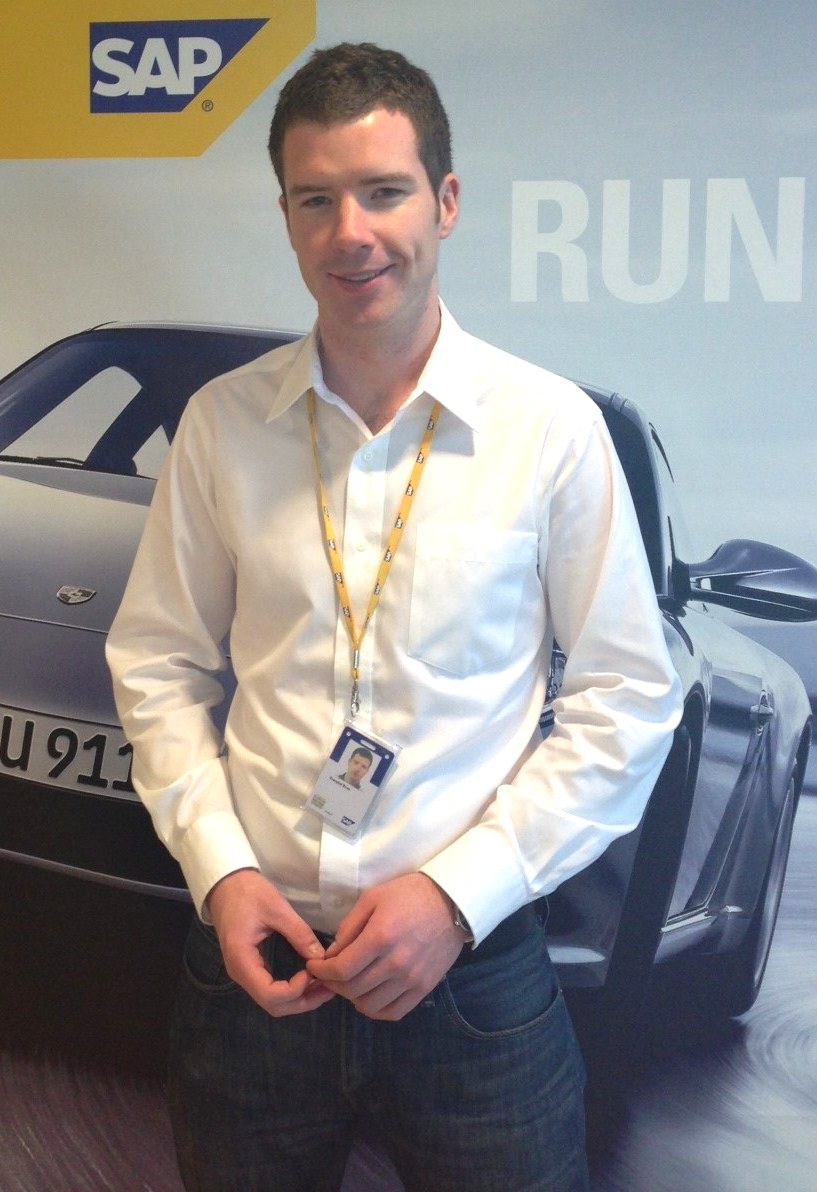
"Hi! I am Johann, currently working as a User Experience Researcher in our SAP headquarters in Newtown Square, PA.  User Experience at SAP has many angles but my work is mostly focused internally: developing new ways to understand our internal processes, tools and strategies and envisioning new ways to support and enhance the ways our SAP employees want to work. 

User Experience and, more recently, Design Thinking, are very powerful approaches to connect with how people feel, think and interact, exploring innovation (technology-based or not) and making sure that it all makes business sense.  The best part is that you get to work with very smart and diverse teams that include people with backgrounds in anthropology, psychology, art, interaction design, architecture, business and many other fields.  My own education shows a bit of that mix:  I started as an undergrad in Systems Engineering with some explorations in Linguistics & Language Education, went to a very unique Master’s program that combined Computer Science with the Science of Creative Intelligence (more about that some other day!) and then, finally did my PhD in Human-Computer Interaction.  Although getting as much knowledge as you can is great, nothing beats working with a diverse team of smart people… and SAP is full of them! 

On the personal side, I love to travel (and to think like a traveler!): my grandparents emigrated from Germany and started a new life in Colombia (South America, where I was born and raised) and I would like to think that I have inherited that desire to see and experience different ways of thinking and living."